
info@oceanuswave.com
sales@oceanuswave.com
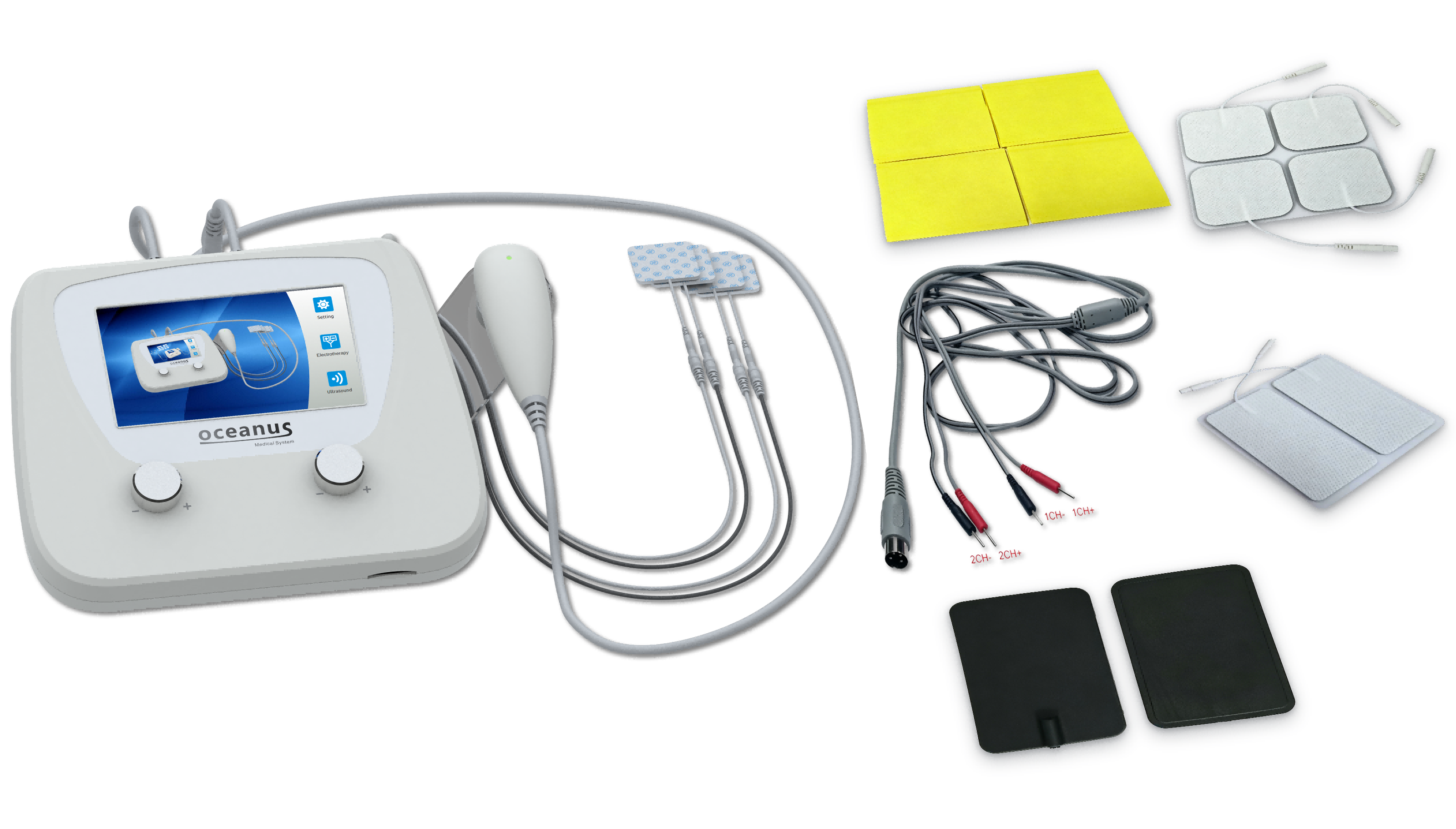
Clinical Application of Oceanus UECT‑001 Combined Ultrasound & Electrotherapy Device
Abstract
Oceanus UECT‑001 is an integrated physical modality system developed by Oceanus Medical, combining therapeutic ultrasound and multi‑wave transcutaneous electrical stimulation. The device supports independent or synchronous activation of ultrasound and electrical stimulation outputs, delivering dual physical stimuli to intact soft tissues and generating synergistic biological responses. This paper elaborates on the technical architecture, detailed waveform characteristics, biological action mechanisms, application scope, safety considerations and supporting literature evidence of the UECT‑001 system.
1. Technical Principle
Oceanus UECT‑001 consists of two fully independent, digitally controlled output subsystems: therapeutic ultrasound module and multi‑waveform transcutaneous electrical stimulation module. Each subsystem has separate power regulation, closed‑loop monitoring and safety interlock circuits.
1.1 Ultrasound module
The ultrasound transducer generates high-frequency mechanical longitudinal acoustic waves. Two selectable operating frequencies are implemented: 1 MHz and 3 MHz.
1 MHz ultrasound: Longer effective penetration depth of approximately 3–5 cm. The acoustic energy targets deep fascia, tendons, joint capsules and peri‑articular soft tissues. It is suitable for deep soft tissue conditioning.
3 MHz ultrasound: Shallow penetration of roughly 1–2 cm, mainly acting on subcutaneous connective tissue and superficial skeletal muscle. It is preferred for superficial tissue intervention.
Ultrasound energy propagates through coupling medium and converts into mechanical vibration within tissue, triggering both thermal and non‑thermal bioeffects including mechanical micro‑massage and controlled stable cavitation. Real‑time acoustic contact detection is embedded to automatically reduce power or pause output when poor coupling is detected, ensuring stable acoustic transmission and preventing local overheating. Output intensity, duty cycle and treatment duration are fully adjustable via the user interface.
1.2 Electrical stimulation module & waveform description
The electrical stimulation module integrates five independent preset waveforms: TENS, Interferential Current (IFC), Neuromuscular Electrical Stimulation (NMES), Russian Square Wave (Russian Current), and Microcurrent. Electrical pulses are delivered to the body through disposable or reusable skin electrodes to activate peripheral sensory and motor nerve fibres.
TENS (Transcutaneous Electrical Nerve Stimulation): Symmetrical or asymmetrical biphasic pulsed square wave, low pulse frequency range. The waveform prioritizes selective activation of Aβ afferent sensory fibres with minimal direct motor excitation. It is designed for sensory modulation and local tissue comfort regulation.
Interferential Current (IFC): Two medium‑frequency sinusoidal carrier signals with slight frequency offset are applied via two pairs of electrodes. The two wave trains interfere inside the target tissue volume and produce a low‑frequency beat amplitude modulation. This beat signal can penetrate deeper than conventional TENS while causing less skin surface irritation.
NMES (Neuromuscular Electrical Stimulation): Biphasic rectangular pulse waveform with adjustable pulse width and frequency. It is configured to depolarize motor nerve axons and trigger synchronized, rhythmic contraction and relaxation of skeletal muscle groups. It is widely used for muscle activation, muscle re‑education and prevention of disuse muscle atrophy.
Russian Square Wave (Russian Current): Medium‑frequency burst‑modulated waveform. Carrier frequency is 2500 Hz, burst modulation frequency is 50 Hz. Each burst lasts 10 ms followed by a 10 ms rest interval, achieving a 50% duty cycle. Within each burst packet is a symmetrical biphasic square wave. This bursted medium‑frequency design reduces skin impedance and cutaneous discomfort while efficiently recruiting a large population of motor units. It is optimized for muscle strength training and functional muscle re‑education.
Microcurrent: Ultra‑low amplitude current in the microampere range, either direct current or low‑frequency alternating current. It exerts subtle modulation on the cellular transmembrane ion exchange and tissue bioelectrical microenvironment, supporting cellular homeostasis and gentle sensory regulation of soft tissues.
1.3 Synergistic working logic
When operated in combined mode, ultrasound is applied first to precondition the target soft tissue. Ultrasonic vibration temporarily increases cell membrane permeability and reduces tissue electrical impedance, which allows the subsequent electrical stimulation to propagate deeper into tissue and improve the uniformity of electrical field distribution. The two physical agents can work simultaneously or sequentially, and users can select and customize built‑in clinical protocols. The host is equipped with multi‑layer safety protections including power limiting, over‑temperature shutdown, electrode impedance monitoring and electrode‑disconnection automatic cut‑off.
2. Biological Action Mechanisms
2.1 Mechanisms of therapeutic ultrasound
Thermal effect: Acoustic energy absorbed by tissue molecules is converted into controlled localized temperature elevation. Moderate heating induces vasodilation of arterioles and capillaries, accelerates regional blood perfusion, facilitates metabolic waste clearance, reduces muscle spindle excitability and resting muscle tone, and improves the viscoelastic properties of collagen‑rich connective tissues such as tendons and fascia, increasing soft tissue extensibility.
Non‑thermal mechanical effect: Microscopic cyclic mechanical vibration promotes interstitial fluid exchange and lymphatic drainage, reduces interstitial oedema and loosens mild soft tissue adhesions. Low‑level stable cavitation gently remodels the extracellular matrix and modulates fibroblast activity, supporting soft tissue adaptation.
2.2 Mechanisms of transcutaneous electrical stimulation
Sensory modulation (TENS / IFC / Microcurrent): TENS and IFC activate large‑diameter Aβ afferent sensory fibres. Following the gate‑control theory of pain, Aβ input inhibits signal transmission from small‑diameter Aδ and C nociceptive fibres at the spinal dorsal horn, and stimulates the release of endogenous opioid peptides to produce sensory relief. Microcurrent acts at cellular level to regulate transmembrane ion flux and restore local bioelectrical balance of soft tissues.
Neuromuscular activation (NMES / Russian Square Wave): Both waveforms depolarize motor nerve fibres to trigger skeletal muscle contraction. Russian square wave’s bursted medium‑frequency characteristic can recruit more fast‑twitch motor units compared with conventional low‑frequency NMES. Repeated contraction‑relaxation cycles maintain muscle mass, counteract disuse atrophy, activate the skeletal muscle pump to promote venous and lymphatic return.
2.3 Synergistic combined mechanism
Ultrasound pre‑treatment modifies tissue biophysical properties to enhance the penetration and uniformity of electrical stimulation. The combined intervention simultaneously improves microcirculation, regulates peripheral nerve excitability, remodels connective tissue mechanical characteristics and modulates cellular activity. Published randomized controlled research demonstrated that combined ultrasound plus transcutaneous electrical stimulation yields superior improvements in sensory comfort level and joint functional mobility than single‑modality intervention for patients with knee degenerative changes and surrounding soft tissue dysfunction.
3. Clinical Application
Oceanus UECT‑001 is intended for use within rehabilitation clinics, sports medicine centres, physiotherapy studios and athletic recovery facilities, delivering physical factor intervention for musculoskeletal soft tissue dysfunction:
Chronic myofascial tightness and myofascial discomfort syndrome
Tendinopathy (non‑ruptured tendon disorders)
Soft tissue stiffness associated with knee osteoarthritis
Delayed onset muscle soreness and post‑exercise soft tissue oedema
Joint mobility limitation secondary to soft tissue adhesion and contracture
Sub‑acute phase soft tissue rehabilitation after musculoskeletal trauma
Neuromuscular re‑education and muscle strength training (Russian Square Wave)
Gentle cellular‑level soft tissue sensory regulation (Microcurrent)
Contraindications: Open skin wounds, active local infection, confirmed deep vein thrombosis, malignant tumour, implanted cardiac pacemaker or defibrillator, metallic implant located within the treatment field, untreated fracture non‑union. Ultrasound application over gravid uterus, eyes and gonads is strictly prohibited.
4. References
[1] Cameron MH. Physical Agents in Rehabilitation: An Evidence-Based Approach to Practice. 5th ed. Elsevier; 2020.
[2] Park JH, Lee S, Kim JH, et al. Efficacy and Safety of a Stimulator Using Low-Intensity Pulsed Ultrasound Combined with Transcutaneous Electrical Nerve Stimulation in Patients with Painful Knee Osteoarthritis. J Clin Med. 2019;8(7):986. PMC6604342.
[3] Avrahami R, Rosenblum J, Gazes M, et al. The efficacy of combined ultrasound and electric field stimulation therapy in the treatment of venous leg ulcers. Wounds. 2015;27:199–208.
[4] Ward AR, Shkuratova N. Russian Electrical Stimulation: The Early Experiments. Phys Ther. 2002;82(10):1019–1030.
[5] Almeida TF, Roizenblatt S, Tufik S. The effect of combined therapeutic ultrasound and electrical stimulation on pain sensitivity in fibromyalgia patients. J Manipulative Physiol Ther. 2003;26(8):487–492.


EMAIL: info@oceanuswave.com sales@oceanuswave.com WEBSITE: www.oceanuswave.com
ADDRESS: No.2,East side,Floor 2, Yinjin Building, Liuxian Road 3, Xin'an Zone 71,Xin'an Subdistrict,Bao'an District, Shenzhen, 518101,Guangdong, P.R. China