
info@oceanuswave.com
sales@oceanuswave.com
Clinical Application of Oceanus REFS‑001 Radiofrequency Physiotherapy
Abstract
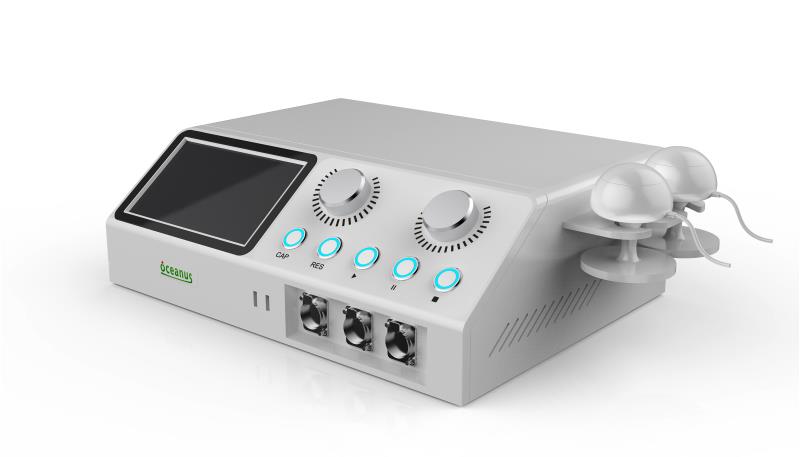
Oceanus REFS‑001 is a 448 kHz monopolar capacitive-resistive electric transfer (TECAR) radiofrequency physiotherapy system manufactured by Oceanus Medical. It provides two working modes: Capacitive Energy Transfer (CET / CAP) and Resistive Energy Transfer (RET / RES). Based on tissue impedance differences, the unit generates controlled endogenous heating and subthermal bioelectrical stimulation inside soft tissues through intact skin. This paper introduces the technical principle, biological mechanisms, clinical applications, safety precautions and supporting literature evidence of REFS‑001.
1. Technical Principle
Oceanus REFS‑001 generates sinusoidal radiofrequency signals, with the RES mode fixed at 448 kHz and the CAP mode dynamically adjustable from 390 kHz to 449 kHz. It adopts a monopolar architecture: the active treatment electrode contacts the patient’s skin, and a neutral return pad forms a closed current loop across the body:
CET (Capacitive / CAP) Mode: The electrode has an insulating dielectric layer. Electric field couples through the epidermis and preferentially acts on low-impedance, water-rich superficial tissues such as skeletal muscle and subcutaneous tissue. It delivers relatively shallow energy for muscle relaxation and microcirculation improvement.
RET (Resistive / RES) Mode: No insulating layer on the electrode. RF current directly penetrates tissue. High-impedance dense connective tissues (fascia, tendons, ligaments) produce stronger Joule heating, achieving deep soft-tissue thermal stimulation.
The core physical mechanism is the Joule effect: charged particles oscillate and rub within the high-frequency electric field to produce endogenous tissue heat. The host is equipped with power limiting, timing cut-off and temperature monitoring functions to avoid excessive thermal injury. Hardware parameters are digitally adjustable to adapt to different tissue conditions and clinical protocols.
2. Biological Action Mechanisms
2.1 Thermal mechanism (primary effect)
Controlled local hyperthermia induces vasodilation, accelerates local blood perfusion and facilitates the clearance of metabolic waste. Tissue heating reduces muscle spindle excitability, lowers resting muscle tone and improves the viscoelasticity of connective tissue, increasing soft tissue extensibility. A published meta-analysis confirmed that TECAR intervention significantly reduces musculoskeletal pain VAS scores and improves physical function after 4–8 weeks of treatment.
2.2 Subthermal non-thermal cellular bioeffect
Under subthermal conditions without obvious temperature elevation, 448 kHz RF electric fields modulate fibroblast activity, collagen synthesis and glycosaminoglycan expression, and regulate heat-shock proteins including Hsp27 and Hsp47. In vitro studies demonstrate that this RF signal can modulate mesenchymal stem cell activity independently of thermal effects, affecting soft tissue remodelling processes.
2.3 Pain modulation mechanism
Two analgesic pathways coexist. First, local heating reduces the excitability of peripheral nociceptors. Second, activation of Aβ sensory fibres follows the gate-control theory, inhibiting nociceptive Aδ and C fibre signal transmission at the spinal level to produce immediate pain relief. Improved microcirculation reduces local oxidative stress and accumulation of pro-nociceptive mediators for sustained symptom relief.
2.4 Musculoskeletal mechanical regulation
Tissue warming accelerates myofibrillar cross-bridge cycling and ATP turnover, improving muscle contractile performance. CET and RET modes deliver graded stimulation to superficial muscle and deep fascia respectively, helping relieve post-exercise muscle fatigue and soft tissue stiffness.
3. Clinical Application
Oceanus REFS‑001 can be applied in rehabilitation clinics, sports medicine centres and physiotherapy studios. It assists physiotherapists in managing soft tissue disorders:
Myofascial tightness and myofascial pain syndrome
Tendinopathy (non-ruptured tendons)
Chronic neck, shoulder and lumbar soft tissue discomfort
Post-exercise muscle fatigue and soft tissue stiffness
Joint stiffness secondary to soft tissue contracture
Contraindications: Open skin wounds, acute inflammatory phase, deep vein thrombosis, malignant tumour, implanted metal devices, non-union fracture, severe osteoporosis; abdominal and lumbar application is prohibited for pregnant women.
4. References
[1] Benito-de-Pedro M, Polo-Peña E, Caballero-García A, et al. Effects of Transfer Energy Capacitive and Resistive On Musculoskeletal Pain: A Systematic Review and Meta-Analysis. J Clin Med. 2023;12(10):3517. PMC9838110.
[2] Fernández J, et al. Acute Effects of Tecar Therapy on Skin Temperature, Ankle Mobility and Hyperalgesia in Myofascial Pain Syndrome in Professional Basketball Players: A Pilot Study. Int J Environ Res Public Health. 2021;18(16):8756. PMC8392258.
[3] Delgado-García G, et al. Effects of the signal modulation on the response of human fibroblasts to in vitro stimulation with subthermal RF currents. J Cosmet Laser Ther. 2021;23(3):147–154.
[4] Clijsen R, Leoni D, Schneebeli A, et al. Does the Application of Tecar Therapy Affect Temperature and Perfusion of Skin and Muscle Microcirculation? A Pilot Feasibility Study on Healthy Subjects. J Altern Complement Med. 2020;26(2):147–153.
[5] García M, et al. TECAR Therapy Associated with High-Intensity Laser Therapy (HILT) and Manual Therapy in the Treatment of Muscle Disorders: A Literature Review on the Theorised Effects Supporting Their Use. Healthcare. 2022;10(11):2144. PMC9604865.


EMAIL: info@oceanuswave.com sales@oceanuswave.com WEBSITE: www.oceanuswave.com
ADDRESS: No.2,East side,Floor 2, Yinjin Building, Liuxian Road 3, Xin'an Zone 71,Xin'an Subdistrict,Bao'an District, Shenzhen, 518101,Guangdong, P.R. China